Binturong R.E.D
In developmentPlay. The tab writes itself.
Binturong R.E.D listens to your guitar and writes down what you played, as notes, tab, and a score you can open in MuseScore, Guitar Pro, or Logic.
In remembrance of Mr. Red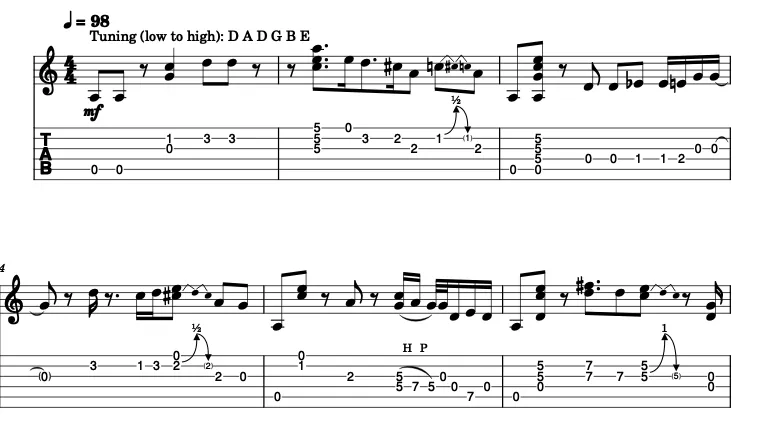
What it does
- Turns a recording (MP3, WAV, FLAC, M4A, and more) into individual notes, including the notes of chords.
- Writes tab with a playable fingering, following where your hand is on the neck. Standard, Drop D, Drop C, and C standard tunings, and four- and five-string bass.
- Writes a full score, notation above tab and in bars, as MusicXML and Guitar Pro files that open in MuseScore, Guitar Pro, Sibelius, Dorico, and Logic.
- Hears bends, vibrato, hammer-ons, and pull-offs, and writes them into the score.
- Finds the tempo, key, and chords, and writes chord symbols above the bars.
- Marks the notes it isn't sure of, so you know exactly what to check by ear.
- A desktop app. Drop in a recording, get tab and a score back.
- A plug-in for Logic and other DAWs, so transcription happens where you already record.
- The pedal. A tuner pedal that quietly transcribes everything you play, started and stopped with a footswitch.
- Tempo out. The pedal follows your playing and sends MIDI clock, so your delays follow you instead of a number you set.
- Learning your guitar's voice to choose the right string and fret more often.
The problem
Every guitarist has played something great in a flow state and then lost it. Recording helps, but listening back and working the part out again is slow, and re-tabbing from a recording rarely recovers the exact notes and the small variations that made it good.
What players need is a scribe: you play, and the transcript simply exists afterward.
The idea: the tuner is already listening
Nearly every pedalboard starts with a tuner. It sits first in the chain, hears your clean signal, and works out the pitch of every note in real time. Then it throws all of that away and shows you a needle.
Binturong R.E.D keeps it. It starts as a tuner and adds a second job running in the background: listen to everything you play, turn it into notes, and save a transcript of the session. It takes no extra room on the board, and it asks nothing new of your routine.
The transcription engine doesn’t depend on the pedal. The same engine runs on a laptop with any audio interface, which is why it’s coming to the desktop first.
How it will reach you
- A desktop app comes first: drop in a recording (bounced from your DAW, or recorded on your phone) and get tab and a score back. It’s the lowest-risk way to put the engine in players’ hands.
- A DAW plug-in follows, built on the same engine.
- The pedal comes last, with the same engine inside, on hardware that’s being prototyped now.
All three run one engine, so an improvement to one is an improvement to all of them.
Your music, in formats you already use
Binturong R.E.D doesn’t lock your music into its own app. Every transcription is written to open formats: MusicXML, which opens and stays editable in MuseScore (free), Guitar Pro, Sibelius, Dorico, and Logic, and native Guitar Pro files. If Binturong R.E.D gets a note wrong, you fix it in the tools you already own.
Measured, not guessed
Accuracy is the product, so it’s measured on every change. The engine is scored against published research datasets of annotated guitar recordings (GuitarSet and Guitar-TECHS) and against a growing set of reference recordings with hand-checked answers. The devlog shares those results, including the parts that don’t work yet.
What’s still hard
- Chords under heavy distortion, and very fast playing, are not solved.
- Tab is ambiguous. The same note can be played in several places on the neck. Binturong R.E.D picks the most playable fingering, and it isn’t always the one you used.
- The pedal is a prototype. The enclosure is being built and the footswitches are on order.
Pricing
There’s no price yet. When there is, it will be one price for software you own, not a subscription.